Industrial modular gas boiler plants provide space heating, domestic hot water, process heat, or steam for manufacturing facilities, residential developments, hotels, retail and office centres, agricultural businesses, and municipal institutions.
Gas is a practical choice where a reliable network connection or an organised supply of liquefied petroleum gas (LPG) is available. However, the boiler plant still requires electricity for pumps, burners, and automation systems. TeploFormat Engineering provides a complete project cycle — from site assessment to equipment commissioning.
When Is a Gas Boiler Plant a Suitable Choice?
A gas boiler plant is suitable for an enterprise with access to a gas distribution network and a need for a controllable heat source. Gas equipment can quickly adjust its output in response to changing daily or seasonal demand.
Industrial gas boiler plants can operate as the primary, backup, or peak-load heat source. They are selected when compact installation is important or when the site cannot accommodate a solid-fuel storage facility. Gas boiler plant reconstruction may include replacing outdated boilers, burners, pumps, and automation systems.
Feasibility is determined after analysing the technical conditions, connection costs, fuel availability, and consumption profile. An industrial gas-fired boiler plant should operate efficiently not only at maximum output but also under partial loads.
Natural Gas, LPG, or Biogas
A natural gas boiler plant is suitable for facilities that can connect to a network with sufficient pressure and flow parameters. Before the design stage, the technical connection conditions must be checked and the available gas volume compared with the calculated demand.
An LPG boiler plant can be used at sites without a connection to the main gas network. The project must address fuel storage, supply and vaporisation, refuelling logistics, and equipment placement.
A biogas boiler plant is relevant for enterprises with their own fuel source. Burner selection must account for the gas composition, calorific value, moisture content, impurities, and the required fuel treatment before combustion.
A dual-fuel gas and diesel boiler plant can provide fuel redundancy. Such combined-fuel boiler plants require a dedicated fuel-system design. Backup liquid-fuel requirements can also be considered alongside solutions for liquid-fuel boiler plants.
Condensing or Conventional Gas Boiler Plant
Conventional gas boilers have a well-established design and are suitable for high-temperature systems. They can be used for space heating and process heat, while the appropriate industrial equipment can also generate steam.
Condensing gas boilers recover additional heat from the condensation of water vapour. They perform best in low-temperature systems. The design must include condensate drainage and, where necessary, neutralisation.
The choice depends on the temperature profile, load pattern, and connection arrangement. For facilities with a wide demand range, a cascade boiler system can be used, with the automation system activating the required number of boilers.
Selecting the Gas Boiler Plant Configuration
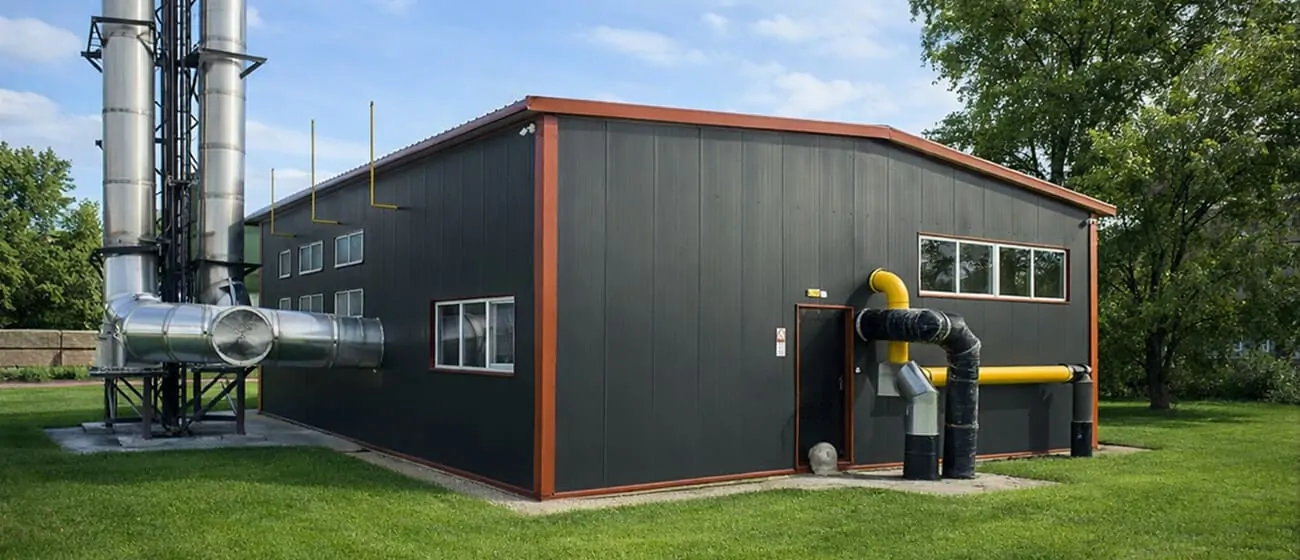
A gas boiler plant can be stationary, freestanding, attached, built into a building, or mobile. A containerised gas boiler plant may be considered for a site with limited space, while a block-modular gas boiler plant provides a high level of factory readiness and faster integration.
A rooftop gas boiler plant can position the heat source closer to consumers, provided the building characteristics allow this type of installation.
The configuration is selected according to the required capacity, system purpose, available site area, distance to consumers, and possibility of supplying gas. Ventilation, chimney requirements, structural restrictions, and the project schedule must also be considered.
Factors Considered During Design
Gas boiler plant design begins with collecting the necessary initial data. Engineers determine:
- the calculated thermal load and demand for domestic hot water, process heat, or steam;
- the temperature profile, gas pressure, and supply parameters;
- primary, backup, and peak operating modes;
- the number of boilers, burner type, and suitability of a cascade arrangement;
- the need for backup fuel, water treatment, and heat-exchange equipment;
- ventilation, flue gas exhaust, and electrical supply requirements;
- the required level of automation, remote monitoring, and provision for future capacity increases.
For a steam boiler plant, the required steam output and parameters are specified separately. All systems must be coordinated rather than selected solely according to the boiler’s rated capacity.
Gas Boiler Plant Automation and Safety
The automation system regulates output, manages the boiler cascade, and responds to weather conditions. It monitors temperature, pressure, flame, draught, and gas concentration, performs emergency shutdowns, and sends notifications.
Integration with BMS or SCADA and remote monitoring through a web interface can be provided where required. An automated boiler plant may operate without permanent on-site personnel only if scheduled inspections, planned maintenance, and all applicable safety procedures are followed.
What Determines the Cost of a Gas Boiler Plant?
The project budget is calculated after analysing the technical specification. The final cost depends on:
- the required thermal capacity and the number and type of boilers and burners;
- the use of natural gas, LPG, biogas, or a combined-fuel configuration;
- the boiler plant format and installation location;
- the level of automation and redundancy requirements;
- water treatment, flue gas exhaust, and the gas supply system;
- the condition of the existing utility networks;
- the scope of design and installation work;
- the need for reconstruction and final commissioning.
Gas boiler plants in Ukraine with the same rated capacity may have different connection conditions and equipment configurations. A universal price per kilowatt without technical data would therefore be inaccurate.
Gas Boiler Plants by TeploFormat Engineering
Gas boiler plant construction includes site assessment, collection of initial data, load calculations, engineering design, and equipment selection and integration. This is followed by factory manufacturing, delivery, installation, and commissioning.
After testing, the customer receives the required documentation, and personnel are trained. TeploFormat Engineering has been operating since 2013 and has completed more than 60 facilities. Examples are available in the Completed Projects section.
The warranty period ranges from 12 to 24 months, depending on the equipment, configuration, and contract terms. Warranty and after-sales service are also available.
To receive a preliminary quotation for a turnkey gas boiler plant, provide information about the facility’s purpose, required capacity, available gas type, temperature profile, installation location, and desired level of automation. Contact TeploFormat Engineering — our specialists will select the equipment configuration and propose a technically justified solution.




 Thermal capacity
  Fuel type
  Equipment (boiler type)
  Application
  Configuration
  Automation and control
  Operating modes
  Turnkey supply
  Power supply
  Flue gas extraction
  Supervisory control system


