Turnkey Modular Solid-Fuel Boiler Plants for Residential, Commercial, Agricultural and Industrial Facilities

We design, equip, install and commission modular solid-fuel boiler plants that provide reliable space heating, domestic hot water and process heat for facilities across a range of sectors.
  • Use of Readily Available Local Fuels
  • Pellets, firewood, wood chips, briquettes and other types of fuel 
  • For residential, agricultural and industrial facilities 
  • Manual, Semi-automatic or Automatic Fuel Feeding 
  • Turnkey installation and commissioning
Turnkey Modular Solid-Fuel Boiler Plants for Residential, Commercial, Agricultural and Industrial Facilities

What Is a Modular Solid-Fuel Boiler Plant?

Solid-fuel boiler plants are reliable heat-generation systems that provide space heating, domestic hot water and process heat for a wide range of facilities. They are used in residential, commercial, agricultural, municipal and industrial applications where an independent heat supply, readily available local fuels, predictable operating costs and reduced dependence on a single energy source are important.

Depending on the boiler design and combustion system, a boiler plant can operate on pellets, firewood, wood chips, briquettes, coal or other solid fuels specified in the design documentation and approved by the equipment manufacturer.

A key advantage of solid-fuel boiler plants is their ability to be adapted to the specific conditions of each facility, including the available fuel, required capacity, operating mode, domestic hot-water demand, process-heat requirements and the desired level of process mechanisation.

Modern systems can include fuel-feeding equipment, automated controls, operating-parameter monitoring, ash-removal systems, remote monitoring and supervisory control. The level of automation is always determined by the equipment type, boiler plant configuration and safe-operating requirements.

Depending on the facility's needs, a solid-fuel boiler plant can be stationary, attached, standalone, block-modular or containerised. Each configuration is selected individually, taking into account the fuel type, heat load, fuel-feeding method, fuel-handling arrangements, equipment-installation conditions, and maintenance and automation requirements.

This approach enables TeploFormat Engineering to deliver a technically sound and economically viable solution tailored to the facility.

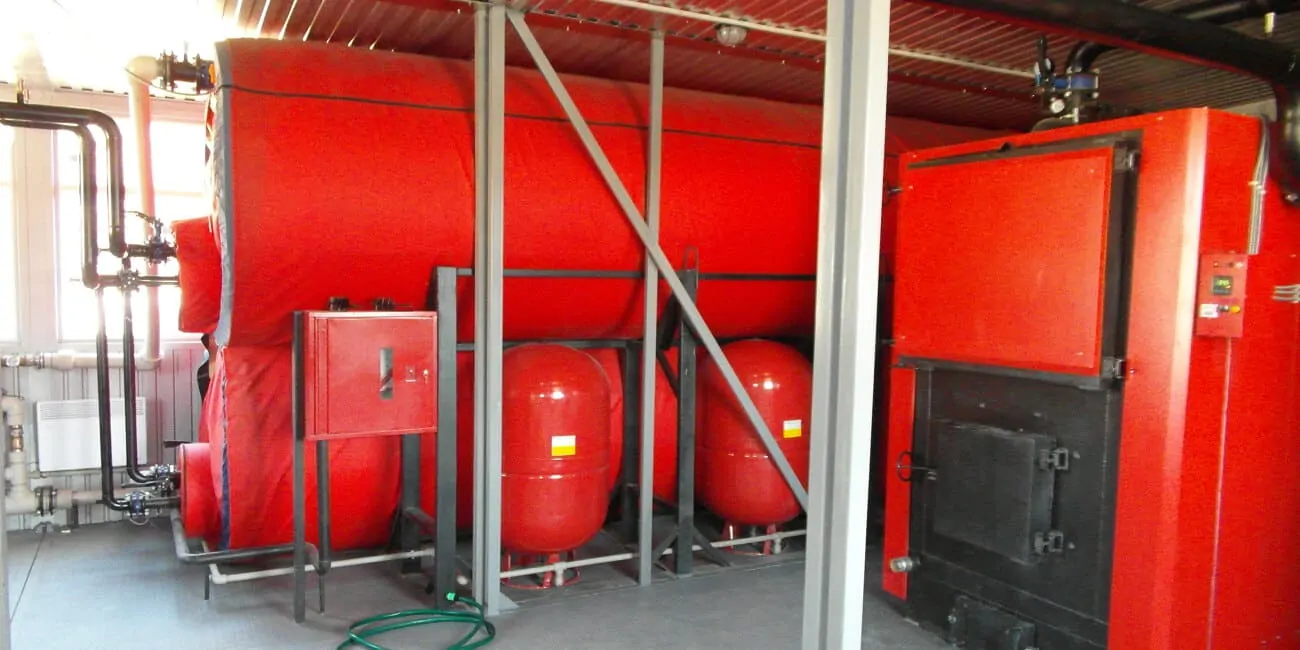
Solid fuel boiler plant with a boiler and buffer tanks
Advantages of Modular Solid-Fuel Boiler Plants

Solid-fuel boiler plants are a practical option for facilities that require flexibility in fuel selection, adaptation to specific operating conditions, predictable costs and a reliable heat supply.

The system configuration can be selected according to the available fuel, required capacity, operating mode and site-specific conditions.

Find the Right Solid-Fuel Boiler Plant for Your Facility
Find the Right Solid-Fuel Boiler Plant for Your Facility Answer 8 questions, and we’ll prepare a preliminary cost estimate and recommend the most suitable system configuration
  • 1
  • 2
  • 3
  • 4
  • 5
  • 6
  • 7
  • 8
Which solid fuels do you plan to use?
Where Are Solid-Fuel Boiler Plants Suitable?

Solid-fuel boiler plants are suitable for facilities that require a reliable independent heat source, have access to an appropriate fuel, or need to reduce their dependence on gas supplies.

Types of Solid-Fuel Boiler Plants
Pellet- and Agricultural-pellet-fired Boiler Plants

Pellets and agricultural pellets offer consistent combustion characteristics, compact storage and the option of automatic fuel feeding. They are suitable where reliable operation and well-organised fuel storage are priorities.

Firewood-fired Boiler Plants

A practical option where firewood is readily available and a straightforward system is preferred. These boiler plants are most often used at small and medium-sized facilities or where periodic manual fuel loading is acceptable.

Wood-waste-fired Boiler Plants

These systems can operate on wood chips, sawdust, shavings and other wood residues. They are particularly suitable for woodworking and manufacturing facilities that generate their own wood waste.

Briquette-fired Boiler Plants

Suitable where compact storage, convenient transport and a consistent fuel format are important. Briquettes are a practical option for boiler plants that need straightforward fuel handling and solid-fuel operation.

Coal-fired Boiler Plants

Used where coal is technically and economically viable. These boiler plants require properly organised fuel storage, ash-removal systems and an appropriate flue-gas extraction system.

Peat- and Peat-briquette-fired Boiler Plants

A specific option for facilities where peat is readily available and can be used as the primary or alternative fuel. The solution is selected according to the fuel characteristics, storage conditions and boiler plant operating mode.

Straw-fired Boiler Plants

A specialised option for agricultural enterprises with a reliable supply of straw or baled straw. The design requires purpose-built arrangements for fuel storage and feeding, together with a combustion system selected specifically for the fuel.

Sunflower-husk and Agricultural-biomass Boiler Plants

A suitable option for agricultural and processing facilities that can use their own by-products as fuel. It makes effective use of locally available fuel and allows the boiler plant to be tailored to the facility's production process.

Boiler Plants Configured for Multiple Solid Fuels

These boiler plants can be configured to operate on several solid fuels, depending on fuel availability and operating conditions. This provides greater flexibility but requires equipment to be selected for the actual characteristics of each fuel.

The right configuration depends not only on the required capacity but also on operating conditions, the available fuel and the characteristics of the facility. The selection process should consider:
How to Select a Solid-Fuel Boiler Plant for Your Facility
Get a Quote

What Is Included in a Solid-Fuel Boiler Plant

The equipment scope depends on the boiler plant type, capacity, fuel, fuel-feeding method and level of automation. A basic solid-fuel boiler plant configuration may include:

  • solid-fuel boilers
  • control and automation system
  • burners and combustion systems
  • safety system
  • fuel hoppers, storage facilities and other fuel-storage containers
  • flue-gas extraction system
  • fuel-feeding systems
  • metering units
  • pump groups
  • electrical switchgear
  • heat-exchange equipment
  • shut-off and control valves
  • water-treatment system
  • instrumentation and measuring devices
  • expansion vessels
  • ash-removal system

Where required, the solution can also include buffer tanks, thermal stores, backup heat sources, automatic ash-removal systems, fuel conveyors, silos, pellet or wood-chip storage facilities, automation panels, remote monitoring and alarm-signal transmission. Remote monitoring does not remove the need to comply with safe-operating procedures or to supervise the boiler equipment as required.

Solid fuel boiler with a pellet burner

Safety, Control and Automation

A modern solid-fuel boiler plant must generate heat efficiently while meeting safety requirements and supporting controlled, stable operation.

The design therefore places particular emphasis on automation, protection and the monitoring of key operating parameters.

  • temperature, pressure and draught monitoring
  • combustion control and overheating protection
  • burn-back protection in the fuel-feeding system
  • automatic shutdown if critical parameter deviations occur
  • control of fuel-feeding equipment and pump groups
  • remote monitoring of operating parameters
  • transmission of alarm messages
  • transmission of signals to a control panel or the facility's monitoring system
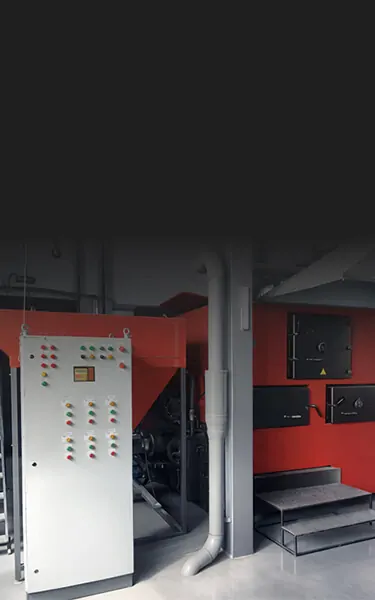
Interior view of a modular boiler plant
Main Technical Specifications
Parameter Configuration Options
Thermal capacity Thermal capacity From small local systems to high-capacity industrial boiler plants; calculated individually according to the facility's requirements.
Fuel type Fuel type Pellets, agricultural pellets, firewood, wood chips, briquettes, coal, peat, baled straw, sunflower husks and other solid fuels.
Equipment (boiler type) Equipment (boiler type) Hot-water or steam solid-fuel boilers, with combustion systems selected according to the fuel, capacity and boiler plant application.
Application Application Space heating, domestic hot water (DHW), process heat and steam generation.
Configuration Configuration Stationary, attached, standalone, block-modular, containerised or transportable boiler plants.
Automation and control Automation and control From basic local control panels to advanced automation systems that monitor key boiler plant operating parameters.
Operating modes Operating modes Primary, backup, peak-load or seasonal operation, depending on the facility's requirements.
Turnkey supply Turnkey supply Boilers, fuel-storage and fuel-feeding systems, pump groups, heat-exchange equipment, automation, water treatment, flue-gas extraction and metering units.
Power supply Power supply Defined by the equipment and automation configuration; where required, the design includes measures to support stable operation of auxiliary systems.
Flue gas extraction Flue gas extraction Design and installation of flue-gas extraction systems according to the fuel, boiler capacity and site-specific requirements.
Monitoring and signal transmission system Monitoring and signal transmission system Monitoring of operating parameters and transmission of alarm signals to a control panel or the facility's monitoring system.
Technical solutions are selected in accordance with applicable regulatory requirements, fuel characteristics, and site operating conditions Request a Quote
Why Clients Choose Us for Solid-Fuel Boiler Plants

We provide more than equipment supply: we deliver a complete solution from initial engineering through to commissioning.

Each project is developed for a specific facility, taking into account the available fuel, heat loads, utility networks, automation requirements and fuel-handling arrangements.

We Design and Build Boiler Plants Tailored to Your Requirements
Frequently asked questions about solid fuel boilers
What fuels can a modular solid-fuel boiler plant use?

Pellets, wood chips, firewood, briquettes, coal, peat or agricultural biomass, provided the boiler and fuel-feed system are designed for the specific fuel, including its moisture content and particle size.

What documents are required for the design, construction and commissioning of a solid-fuel boiler plant?

Evidence of rights to the site, technical connection conditions, engineering surveys and design documentation are required. For CC1 projects, a commencement notice and declaration of readiness are filed; CC2/CC3 projects require a permit and completion certificate. Fire-safety, environmental and occupational-safety documents are also required where applicable.

How is the required capacity of a solid-fuel boiler plant determined?

The required capacity is based on the calculated loads for space heating, ventilation, domestic hot water and process heat. The number of boilers and the backup capacity depend on the load profile and reliability category.

How much fuel does a solid-fuel boiler plant consume?

As a guide: m = Q/(η×q). For a 100 kW plant firing pellets, full-load consumption is approximately 22–27 kg/h; the exact figure depends on efficiency and fuel properties.

Can a solid-fuel boiler plant operate automatically without permanent on-site staff?

Yes, provided this is allowed by the design and the applicable equipment rules. Remote monitoring, automatic controls, alarms and safety interlocks are required. Scheduled inspections and maintenance by qualified personnel remain mandatory.

How is the fuel bunker and automatic fuel-feed system protected against fire?

The design provides fire separation, fire detection and suppression, emergency shutdown and protection against fire spreading back through the fuel-feed system. The specific measures depend on the fuel and equipment.

What is included in the turnkey price of a solid-fuel boiler plant?

The cost estimate and contract define the exact scope. It typically includes the design, module, boilers, fuel store and handling system, controls, flue-gas extraction system, delivery, installation, commissioning and operator training.

What determines the price and manufacturing lead time of a solid-fuel boiler plant?

The main factors are capacity, fuel type, number of boilers, fuel storage and handling, ash removal, flue-gas cleaning, level of automation, site readiness, design scope, logistics and equipment lead times.

Industrial Modular Solid-Fuel Boiler Plants

Industrial modular solid-fuel boiler plants provide space heating, domestic hot water, steam, and process heat. They are suitable for manufacturing and agricultural enterprises, residential developments, municipal facilities, and commercial properties, especially where a local or on-site fuel resource is available.

This solution reduces dependence on gas supplies and other centralised energy sources. However, electrical power may still be required for automation, pumps, and fuel-feeding mechanisms. TeploFormat Engineering provides a complete scope of services—from site assessment and engineering calculations to commissioning the boiler plant.

When Is a Solid-Fuel Boiler Plant a Suitable Choice?

A solid-fuel boiler plant is a practical option when an enterprise has stable access to fuel with predictable characteristics and can arrange suitable storage facilities. This is particularly relevant for sites without a connection to the gas network, as well as woodworking, agricultural, and processing enterprises that generate wood waste or agricultural biomass.

Industrial solid-fuel boiler plants can serve as the primary, backup, or peak-load heat source. They are used for industrial heating, drying, water heating, and other production processes. Where necessary, the system can supplement a gas-fired boiler plant or form part of a solution incorporating combined-fuel boiler plants.

The final decision should be based on a technical and economic comparison of the available options. The assessment should consider not only the fuel price but also logistics, storage costs, fuel preparation, personnel requirements, equipment cleaning, and ash handling.

How to Select Solid Fuel for a Boiler Plant

Fuel is assessed according to its calorific value, moisture content, ash content, and consistency. Other important factors include availability throughout the heating season, delivery distance and cost, required storage area, and the possibility of mechanised feeding.

A pellet-fired or wood-chip boiler plant can include automatic fuel feeding from a bunker or storage facility. Chip size and moisture content are particularly important for wood chips because they affect the selection of conveying equipment and the combustion system. A firewood boiler plant generally requires more manual operations, although the specific level of mechanisation depends on the system’s capacity and design.

An agricultural biomass boiler plant can use straw, sunflower husks, agricultural pellets, and other production by-products. A straw-fired boiler plant requires sufficient storage space and a specially selected feeding system.

For briquettes, coal, and agricultural biomass, the design must also consider flue gas exhaust, gas cleaning, and ash disposal requirements. The boiler and fuel-handling system should be selected according to the fuel’s actual characteristics rather than its nominal specifications alone.

What Is Included in a Solid-Fuel Boiler Plant?

A solid-fuel boiler plant is an integrated system in which every component is selected according to the fuel type, required thermal capacity, and load profile. The configuration may include:

  • one or more boilers, combustion units, and safety systems;
  • a fuel storage facility, bunker, conveyors, and fuel-feeding mechanisms;
  • pump groups, heat exchangers, and buffer tanks;
  • water treatment equipment, metering units, and control valves;
  • ash removal systems, a chimney, flue gas exhaust, and gas-cleaning equipment;
  • electrical equipment, automation, and remote monitoring systems.

The equipment configuration is determined after the necessary calculations have been completed. For example, a block-modular solid-fuel boiler plant designed for a steady load will have a different layout from a backup boiler plant that operates only during specific periods.

Manual or Automatic Fuel Feeding

The fuel-loading method affects the boiler plant design, personnel requirements, and fuel storage arrangements:

  • manual loading is primarily used for lower-capacity systems with relatively simple operating conditions;
  • semi-automatic feeding combines mechanised processes with periodic personnel involvement;
  • automatic fuel feeding is suitable for regular loads and reduces the amount of manual work required.

An automated boiler plant does not operate entirely without human involvement. Personnel must monitor fuel availability and quality, the condition of mechanical systems, ash accumulation, combustion parameters, and scheduled maintenance.

What Determines the Cost of a Solid-Fuel Boiler Plant?

The cost depends on more than the installed boiler capacity. The project budget is influenced by:

  • the required thermal capacity and the number and type of boilers;
  • the primary and backup fuel types;
  • the method of fuel storage, preparation, and feeding;
  • the level of automation and the complexity of ash removal and gas-cleaning systems;
  • modular or stationary configuration;
  • the condition of the existing utility networks and the scope of installation work;
  • the need for design services, expert assessment, and final commissioning.

Solid-fuel boiler plants in Ukraine may have the same rated capacity but differ considerably in their configuration and operating conditions. A quotation should therefore be prepared after analysing the facility and the selected fuel rather than using a universal price per kilowatt.

Solid-Fuel Boiler Plant Delivery by TeploFormat Engineering

Solid-fuel boiler plant construction begins with a site assessment, collection of initial data, and calculation of thermal loads. The team then selects the fuel and equipment, prepares the engineering design, performs factory manufacturing, and completes delivery, installation, and commissioning.

After testing, the customer receives the required documentation, and operating personnel are trained. TeploFormat Engineering has been operating since 2013 and has completed more than 60 projects. Examples are available in the Completed Projects section.

Warranty and after-sales service are available following commissioning, with the exact scope determined by the contract terms.

To select a turnkey solid-fuel boiler plant for your facility, provide information about the required capacity, system purpose, available fuel, operating schedule, and installation location. Contact TeploFormat Engineering – our specialists will analyse the initial data, recommend a suitable configuration, and prepare a preliminary quotation.