Industrial combined boiler plants integrate two or more heat sources into a single system. Unlike a single-fuel boiler plant, they can combine gas, electricity, solid fuel, and liquid fuel, distributing primary, backup, peak, or seasonal loads between different units.
This improves heat supply reliability when the equipment configuration and control algorithms are tailored to the facility’s requirements. A combined solution is not always less expensive: the result depends on energy tariffs, fuel availability, and the operating schedule. Teploformat Engineering provides a complete project cycle—from site assessment to system commissioning.
When Is a Multi-Fuel Boiler Plant a Suitable Choice?
Multi-fuel boiler plants are suitable where disruption to one energy source could stop production or affect a critical facility. They provide emergency backup, cover seasonal and daily load fluctuations, or change over between sources according to a predefined algorithm.
A backup heat supply system is particularly important for facilities where interruption of heating would have critical consequences.
The system can combine locally available solid fuel with an automated backup source, supplement an existing boiler plant, or allow capacity to be increased in stages. The configuration is selected following a technical and economic comparison.
Common Energy-Source Combinations
The practical arrangement depends on the available resources and the role assigned to each source:
- Gas + diesel fuel. Gas-fired boiler plants operate in the base-load mode, while diesel provides backup. A gas-diesel boiler plant can use separate boilers or a factory-built dual-fuel gas/liquid-fuel burner.
- Gas + electricity. Gas covers the primary load, while the electric boiler serves as a backup or peak-load source. The available electrical capacity must be verified.
- Solid fuel + electricity. Solid-fuel boiler plants provide the base heat output, while the electric section responds quickly to changing demand. A thermal storage tank may be included in the system.
- Solid fuel + liquid fuel. Diesel fuel or heating oil provides a rapid start when the primary solid-fuel equipment is unavailable. Backup requirements can be assessed together with solutions for liquid-fuel boiler plants.
- Gas + solid fuel. The system combines automated gas-fired operation with the use of available solid fuel. The hydraulic system and automation must be properly coordinated.
There is no universal rule for selecting the primary source. Gas may take priority at one facility, while another may prioritise local fuel or electric boiler plants when the available electrical capacity permits.
Assigning Roles to the Heat Sources
Primary and backup heat sources operate alternately. In a “primary + peak-load” configuration, an additional unit covers periods of maximum demand. With a “base-load + peak-load” arrangement, one source operates continuously while the other is brought online during peak periods.
Seasonal changeover and cascade control are also possible. Backup capacity is calculated according to the critical load that must be maintained during an emergency.
Automatic Changeover Between Heat Sources
Automatic changeover may depend on the heat-transfer fluid temperature, current load, outdoor conditions, equipment status, and fuel availability or pressure. The available network capacity must also be considered for the electric section.
The automation system may operate according to a timed schedule, predefined source priority, or a dispatcher’s command. However, automatic backup activation is possible only when supported by the boiler design, fuel infrastructure, and project-specific control algorithm.
Factors Considered During Design
Multi-fuel boiler plant design covers:
- calculated, minimum, and critical thermal loads;
- available energy sources, tariffs, and supply reliability;
- boiler and burner types, temperature profiles, and operating modes;
- gas infrastructure and solid- or liquid-fuel storage;
- available electrical capacity and redundancy requirements;
- hydraulic integration, heat exchangers, and buffer tanks;
- flue-gas extraction, automation, supervisory control, and future expansion.
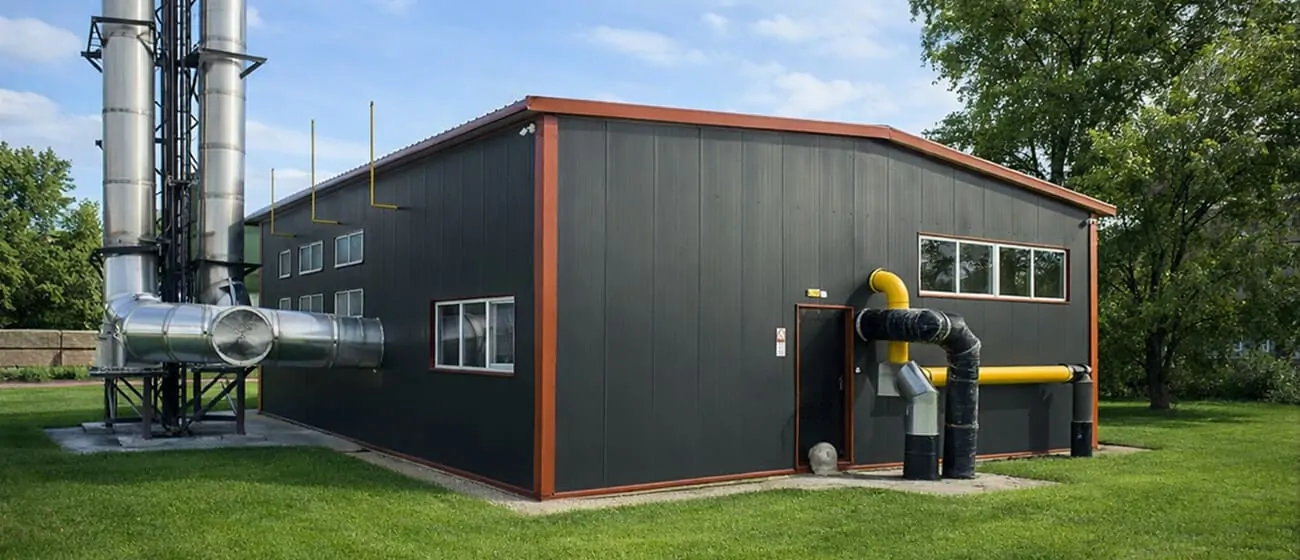
A block-modular multi-fuel boiler plant can integrate equipment within one or more modules. However, modular multi-fuel boiler plants still require coordination with the site’s external utility networks and fuel infrastructure.
Hydraulic Integration of the Equipment
Different heat sources may operate with different temperature profiles, pressures, heat-transfer fluid flow rates, start-up times, and permissible return-water temperatures. A multi-fuel boiler plant therefore involves more than simply connecting two boilers in parallel.
Hydraulic separators, heat exchangers, manifolds, pump groups, and mixing units can be used to coordinate the circuits. A buffer tank helps compensate for differences in source response times.
Safety and Supervisory Control
The control system monitors temperature, pressure, burners, pump groups, and fuel infrastructure. It can manage a boiler cascade, select source priority, activate backup equipment, archive operating parameters, and transmit alarm notifications.
Supervisory control includes remote monitoring and integration with BMS or SCADA. The collected data may also be used by an energy management system. Automatic source changeover functions depend on the specific equipment configuration rather than the presence of a monitoring system alone.
What Determines the Cost of a Multi-Fuel Boiler Plant?
The project budget depends on the total thermal capacity, number of heat sources, backup capacity, energy sources, and boiler and burner types. Other factors include the complexity of the hydraulic system, fuel infrastructure, thermal storage or buffer tanks, automation level, and changeover algorithms.
The installation format, reconstruction of the existing system, and scope of design and installation work also affect the cost. Multi-fuel boiler plants in Ukraine with the same total capacity may have fundamentally different equipment configurations, so a universal price per kilowatt would be inaccurate.
Multi-Fuel Boiler Plants by Teploformat Engineering
Teploformat Engineering assesses the facility, calculates the thermal load, analyses available energy sources, and compares possible configurations. The team develops the hydraulic design, selects the primary and backup equipment, designs the automation system, and performs manufacturing, integration, multi-fuel boiler plant installation, and commissioning.
The company has been operating since 2013 and has completed more than 60 projects. Examples are available in the Portfolio section.
After the operating algorithms are configured, the customer receives the required documentation, personnel training, and technical support. The warranty period ranges from 12 to 24 months, depending on the equipment, configuration, and contract terms.
To receive a preliminary cost estimate, provide information about the thermal load, available energy sources, operating mode, and redundancy requirements. Teploformat Engineering specialists will define the role of each source, develop the coordinated operating logic, and recommend a suitable equipment configuration.




 Thermal capacity
  Equipment (boiler type)
  Application
  Configuration
  Automation and control
  Operating modes
  Turnkey supply
  Supervisory control system
  Type of energy carrier
  Fuel infrastructure


